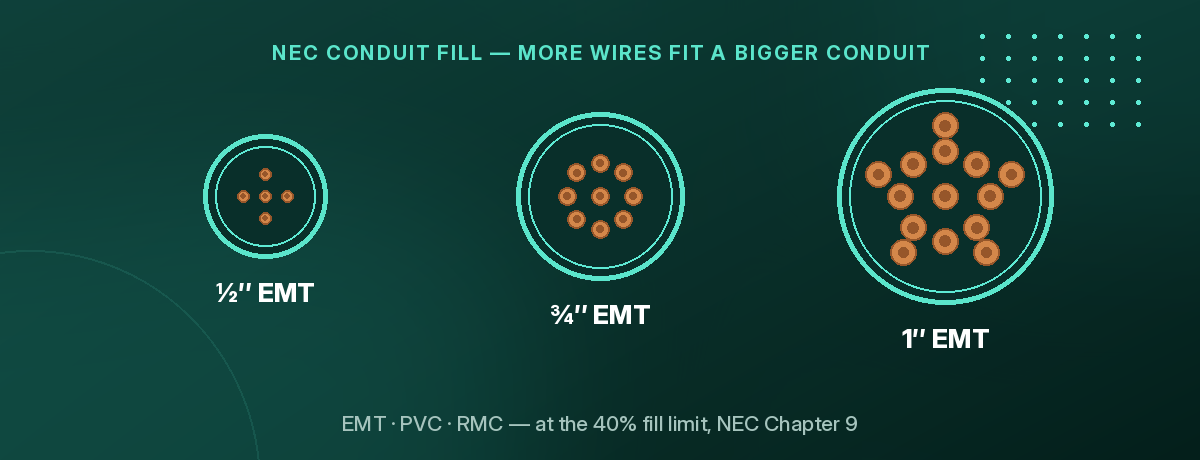
How many wires fit in a conduit? The answer is a percentage, not a guess. NEC Chapter 9 fixes the area each conductor takes and the area each conduit gives, and a fill chart turns that math into a number you can read at a glance. This page has the charts for EMT, PVC, and RMC, plus how to use them and a conduit fill calculator for any combination.
A conduit carrying three or more wires may be filled to 40% of its inside area. At that limit, ½-inch EMT holds 9 of #12 THHN, ¾-inch holds 16, and 1-inch holds 26. PVC of the same trade size holds a few less. Count every conductor, including the ground.
The Quick Answer
A conduit fill chart tells you the most conductors of one size that fit a given conduit. The limit comes from NEC Chapter 9, Table 1: 40% fill for three or more conductors, 31% for two, and 53% for a single conductor. To read a chart, find your wire size on the left and your conduit size across the top. The cell where they meet is the maximum count.
- 40% is the everyday limit. Almost every run has three or more conductors, so 40% is the number you will use most.
- Bigger wire fills faster. A 6 AWG conductor takes nearly four times the room of a 12 AWG, so a few large wires fill a conduit quickly.
- PVC holds less than EMT. For the same trade size, PVC has slightly less inside area, and Schedule 80 PVC has the least of all.
What Is Conduit Fill?
Conduit fill is the share of a conduit's inside cross-section taken up by the conductors inside it. Picture the end of a pipe: the wires are small circles inside a larger circle, and fill is the ratio of their combined area to the pipe's open area. NEC Chapter 9 publishes both areas, so the result is exact rather than an estimate.
Two problems set the limit. Heat is the first. Bundled conductors trap warmth, which is why the NEC derates ampacity once more than three current-carrying wires share a raceway. Pulling tension is the second. A packed conduit drags insulation across the other wires and the conduit edges, and a nicked conductor can fault later. The 40% cap holds both in check, and it is why a fill chart is worth keeping on hand.
EMT Conduit Fill Chart
EMT (electrical metallic tubing) is the most common conduit for indoor and exposed work, and it has the most room of the steel types. The chart below gives the maximum number of THHN/THWN-2 conductors per trade size at the NEC fill limit. These counts match NEC Annex C.
| Wire (THHN) | ½″ | ¾″ | 1″ | 1¼″ | 1½″ | 2″ |
|---|---|---|---|---|---|---|
| 14 AWG | 12 | 22 | 35 | 61 | 84 | 138 |
| 12 AWG | 9 | 16 | 26 | 45 | 61 | 101 |
| 10 AWG | 5 | 10 | 16 | 28 | 38 | 63 |
| 8 AWG | 3 | 6 | 9 | 16 | 22 | 36 |
| 6 AWG | 1 | 4 | 7 | 12 | 16 | 26 |
| 4 AWG | 1 | 2 | 4 | 7 | 10 | 16 |
| 3 AWG | 1 | 1 | 3 | 6 | 8 | 13 |
| 2 AWG | 1 | 1 | 3 | 5 | 7 | 11 |
| 1 AWG | 1 | 1 | 1 | 4 | 5 | 8 |
| 1/0 AWG | 0 | 1 | 1 | 3 | 4 | 7 |
| 2/0 AWG | 0 | 1 | 1 | 2 | 3 | 6 |
| 3/0 AWG | 0 | 1 | 1 | 1 | 3 | 5 |
| 4/0 AWG | 0 | 0 | 1 | 1 | 1 | 4 |
For example, ¾-inch EMT holds sixteen 12 AWG THHN, and 1-inch holds twenty-six. When a run mixes conductor sizes, the chart no longer applies directly: total each size's area and compare the sum to 40% of the conduit area, which the conduit fill calculator does for you.
PVC Conduit Fill Chart (Schedule 40 & 80)
PVC is the standard for underground and wet locations. Schedule 40 is the common wall thickness; Schedule 80 has thicker walls for physical protection, which leaves less room inside. Both hold slightly fewer conductors than EMT of the same trade size.
PVC Schedule 40: Max THHN Conductors
| Wire (THHN) | ½″ | ¾″ | 1″ | 1¼″ | 1½″ | 2″ |
|---|---|---|---|---|---|---|
| 14 AWG | 11 | 21 | 34 | 60 | 82 | 135 |
| 12 AWG | 8 | 15 | 25 | 43 | 59 | 99 |
| 10 AWG | 5 | 9 | 15 | 27 | 37 | 62 |
| 8 AWG | 3 | 5 | 9 | 16 | 21 | 36 |
| 6 AWG | 1 | 4 | 6 | 11 | 15 | 26 |
| 4 AWG | 1 | 1 | 4 | 7 | 9 | 16 |
| 3 AWG | 1 | 1 | 3 | 6 | 8 | 13 |
| 2 AWG | 1 | 1 | 3 | 5 | 7 | 11 |
| 1 AWG | 0 | 1 | 1 | 3 | 5 | 8 |
| 1/0 AWG | 0 | 1 | 1 | 3 | 4 | 7 |
| 2/0 AWG | 0 | 1 | 1 | 2 | 3 | 6 |
| 3/0 AWG | 0 | 1 | 1 | 1 | 3 | 5 |
| 4/0 AWG | 0 | 0 | 1 | 1 | 1 | 4 |
PVC Schedule 80: Max THHN Conductors
| Wire (THHN) | ½″ | ¾″ | 1″ | 1¼″ | 1½″ | 2″ |
|---|---|---|---|---|---|---|
| 14 AWG | 9 | 17 | 28 | 51 | 70 | 118 |
| 12 AWG | 6 | 12 | 20 | 37 | 51 | 86 |
| 10 AWG | 4 | 7 | 13 | 23 | 32 | 54 |
| 8 AWG | 1 | 4 | 7 | 13 | 18 | 31 |
| 6 AWG | 1 | 3 | 5 | 9 | 13 | 22 |
| 4 AWG | 1 | 1 | 3 | 6 | 8 | 14 |
| 3 AWG | 1 | 1 | 3 | 5 | 7 | 12 |
| 2 AWG | 0 | 1 | 1 | 4 | 6 | 10 |
| 1 AWG | 0 | 1 | 1 | 3 | 4 | 7 |
| 1/0 AWG | 0 | 1 | 1 | 2 | 3 | 6 |
| 2/0 AWG | 0 | 0 | 1 | 1 | 3 | 5 |
| 3/0 AWG | 0 | 0 | 1 | 1 | 1 | 4 |
| 4/0 AWG | 0 | 0 | 1 | 1 | 1 | 3 |
Notice how the counts drop from Schedule 40 to Schedule 80 at the same trade size. The thicker Schedule 80 wall is the reason, so always size from the schedule you are actually installing.
RMC Conduit Fill Chart
RMC (rigid metal conduit) is heavy threaded steel used where maximum protection is needed, such as risers and hazardous areas. Its internal area is close to EMT, so the conductor counts are similar.
| Wire (THHN) | ½″ | ¾″ | 1″ | 1¼″ | 1½″ | 2″ |
|---|---|---|---|---|---|---|
| 14 AWG | 13 | 22 | 36 | 63 | 85 | 140 |
| 12 AWG | 9 | 16 | 26 | 46 | 62 | 102 |
| 10 AWG | 6 | 10 | 17 | 29 | 39 | 64 |
| 8 AWG | 3 | 6 | 9 | 16 | 22 | 37 |
| 6 AWG | 1 | 4 | 7 | 12 | 16 | 27 |
| 4 AWG | 1 | 2 | 4 | 7 | 10 | 16 |
| 3 AWG | 1 | 1 | 3 | 6 | 8 | 14 |
| 2 AWG | 1 | 1 | 3 | 5 | 7 | 11 |
| 1 AWG | 1 | 1 | 1 | 4 | 5 | 8 |
| 1/0 AWG | 0 | 1 | 1 | 3 | 4 | 7 |
| 2/0 AWG | 0 | 1 | 1 | 2 | 3 | 6 |
| 3/0 AWG | 0 | 1 | 1 | 1 | 3 | 5 |
| 4/0 AWG | 0 | 0 | 1 | 1 | 1 | 4 |
RMC and EMT hold nearly the same number of conductors per trade size, while PVC holds a little less. If your run could use either, the metal types give marginally more room.
What Are the NEC Conduit Fill Limits?
The fill limit is not a single number. It depends on how many conductors are in the conduit, because the pulling and cooling problems change with the count. NEC Chapter 9, Table 1 sets three values.
| Number of Conductors | Maximum Fill | Reason |
|---|---|---|
| 1 conductor | 53% | Pulls straight and cools easily |
| 2 conductors | 31% | Two round wires leave a binding gap |
| 3 or more conductors | 40% | Pack efficiently; the usual case |
These limits apply to conduit 24 inches or longer. A short nipple, a length of 24 inches or less between two boxes, may be filled to 60% under NEC 314.16, because pulling and heat are not concerns over such a short run.
How Do You Read a Conduit Fill Chart?
Reading the chart is a two-step lookup. Find your conductor size in the left column, then read across to your conduit trade size. The cell is the maximum number of that conductor the conduit holds at the NEC limit. If you have fewer than that number, you are within code; if you need more, step up a trade size and look again.
Two cautions. First, the charts here are for THHN/THWN-2, the most common building wire. XHHW-2 and THW are larger for the same gauge, so they fill more of the conduit and the counts would be lower. Second, the chart assumes all conductors are the same size. For a mixed run, the chart is only a starting point, and you should total the areas instead.
How to Calculate Conduit Fill
Behind every chart cell is a short calculation you can do by hand. It is three steps.
- Total the conductor areas. Look up each conductor's area in NEC Chapter 9, Table 5, and multiply by the count. A 12 AWG THHN is 0.0133 square inches.
- Find the conduit's inside area. Table 4 lists it by type and trade size. A ½-inch EMT is 0.304 square inches inside.
- Divide, then check the limit. Conductor area divided by conduit area is the fill percentage. Compare it to the 40% limit for three or more wires.
Worked example: nine 12 AWG THHN take up 9 × 0.0133 = 0.1197 square inches. In ½-inch EMT that is 0.1197 ÷ 0.304 = 39.4%, just under the 40% limit. So nine is the most that fit, which is exactly what the EMT chart shows. To skip the arithmetic, the conduit fill calculator returns the percentage, the minimum conduit size, and the maximum count for any combination.
Common Conduit Fill Mistakes
- Forgetting the ground. The equipment grounding conductor counts toward fill, and so do neutrals. Leaving them out is the most common reason a conduit comes up over the limit on inspection.
- Reading the wrong insulation. A chart built for THHN does not apply to XHHW or THW, which take more room. Match the chart to the wire you are pulling.
- Mixing sizes against a single-size chart. The chart assumes one conductor size. For a mix of sizes, total the areas and compare to the 40% area instead.
- Ignoring derating. Passing the fill test does not mean the wires are big enough. More than three current-carrying conductors derates ampacity, which can force a larger wire.
- Confusing the nipple rule. The 60% allowance is only for lengths of 24 inches or less. A normal run is capped at 40%.
Key Takeaways
- Conduit fill is the conductors' combined area divided by the conduit's inside area, both from NEC Chapter 9.
- The limit is 40% for three or more conductors, 31% for two, and 53% for one.
- ½-inch EMT holds 9 of #12 THHN, ¾-inch holds 16, and 1-inch holds 26; PVC holds slightly fewer.
- PVC Schedule 80 has the thickest walls and the least room; EMT and RMC hold the most.
- Count every conductor, including grounds and neutrals, and match the chart to your insulation type.
- Charts assume one conductor size; total the areas for mixed runs, or use the conduit fill calculator.


